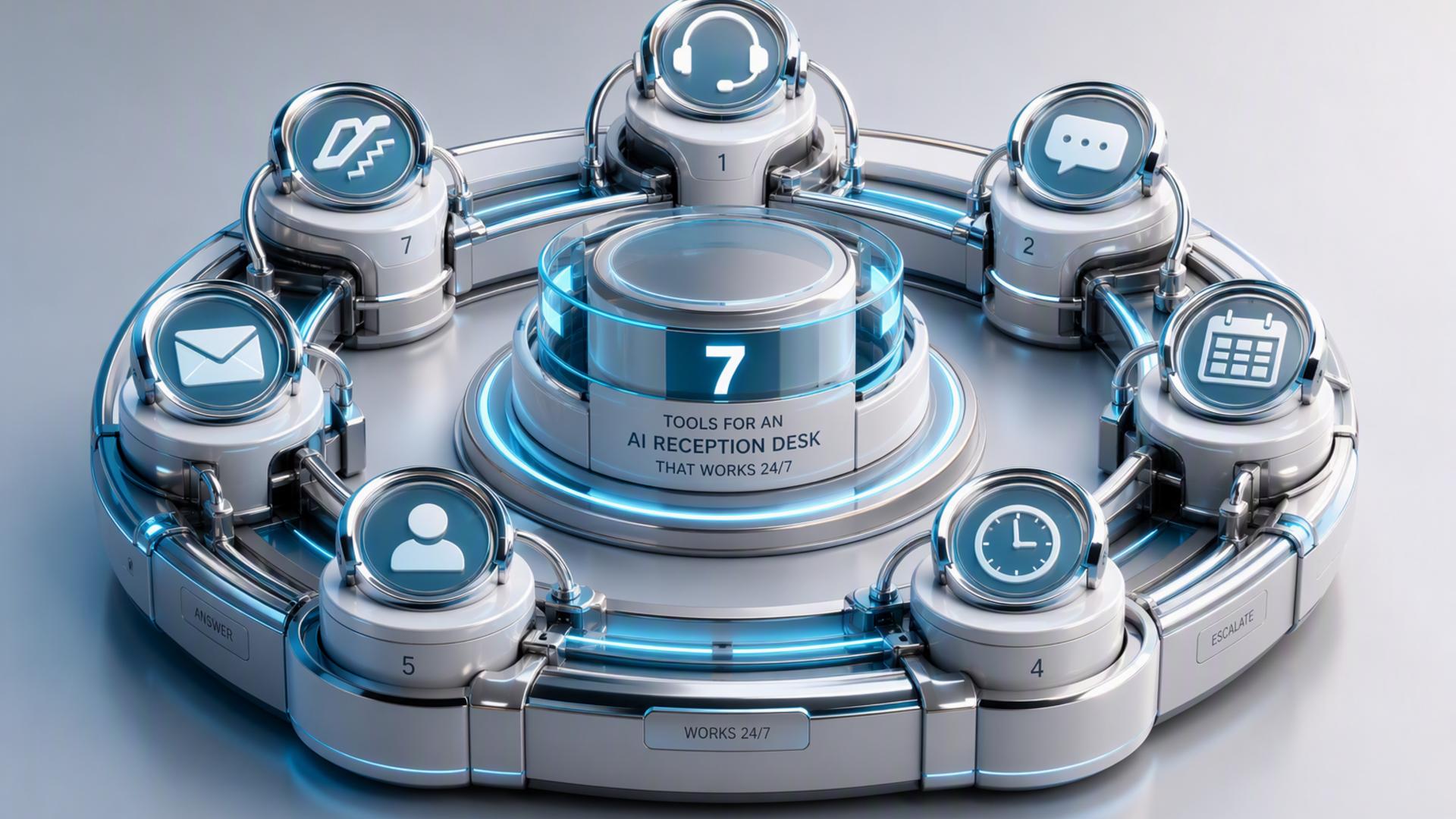
A dependable AI front desk is more than a system that simply answers the phone. To create a genuinely useful 24/7 reception experience, businesses need several pieces working together, including call handling, scheduling, customer records, internal communication, support management, and workflow automation.
The right combination allows a caller's request to move naturally from conversation to action. An AI receptionist can collect the initial information, while connected tools help schedule appointments, record leads, alert staff, open support tickets, and keep calendars accurate. The following seven tools can each play an important role in building that connected system.
If the goal is to create an actual 24/7 AI reception system, DialMyCalls AI Receptionist is the natural place to start. It occupies the front line of the workflow by answering incoming calls around the clock, including after business hours, weekends, and other times when staff may not be available. Instead of sending callers directly to voicemail, the AI can hold a natural conversation, answer common questions, collect contact details, understand why someone is calling, and take messages for follow-up.
That makes DialMyCalls especially useful because it addresses the part of the customer journey that traditionally requires a receptionist to be immediately available. Businesses can provide information about their operations, FAQs, business hours, and preferred greeting so the AI assistant has the context needed to respond appropriately. The result is an always-available first point of contact rather than a collection of disconnected automation tools sitting behind an unanswered phone line.
The value becomes even clearer when DialMyCalls is connected with the rest of the business technology stack. Its AI Receptionist can work alongside existing phone systems, with DialMyCalls documenting integrations for platforms such as RingCentral, Aircall, Grasshopper, OpenPhone, and others. This makes it possible to use AI for all calls, overflow traffic, or after-hours coverage while retaining an established business phone setup.
For a complete AI front desk, other applications can then take over after the conversation. Scheduling software can handle appointments, a CRM can organise lead information, Slack can alert employees, and automation tools can move data between systems. Those components are valuable, but DialMyCalls provides the element that makes the overall setup feel like a receptionist in the first place: an intelligent voice answering customers whenever they decide to call.
Zapier is useful when an AI reception workflow involves several applications that do not naturally exchange information on their own. It acts as an automation layer between business software, allowing an event in one application to trigger an action somewhere else. Zapier currently supports integrations across thousands of applications, making it particularly versatile for businesses that already use a varied collection of cloud tools.
Zapier calls its automated workflows Zaps. A Zap begins with a trigger and then performs one or more actions, such as creating a CRM record after receiving new lead information or sending a Slack notification when an important request is submitted. The underlying idea is simple: information should move automatically instead of waiting for an employee to copy it manually from one system to another.
This can become particularly helpful as an AI front desk grows beyond its first few connections. A business might want one type of enquiry routed to sales, another sent to customer service, and appointment requests recorded separately. Zapier provides a way to build those pathways without developing an entirely custom integration platform.
Zapier is therefore best viewed as connective tissue rather than the receptionist itself. It does not replace the conversational call-handling layer, but it can make the information produced by that layer much more useful. For businesses using several specialised applications, it is an effective way to reduce repetitive administration and keep front desk processes moving after the caller hangs up.
Google Calendar can provide a straightforward scheduling backbone for an AI-assisted front desk, particularly for organisations already operating within Google Workspace. Instead of managing availability in a separate spreadsheet or relying on employees to check schedules manually, appointments and availability can remain centred around the calendars staff already use throughout the working day.
Google Calendar supports appointment schedules, including booking pages that allow other people to reserve available times. Appointment schedules can also check calendars for conflicts, helping businesses avoid offering times that overlap with existing commitments. Depending on the account and subscription level, additional scheduling capabilities are available as part of Google's appointment scheduling features.
Within an AI receptionist setup, Google Calendar is especially practical when the main requirement is keeping bookings visible to the people who need to attend them. Once an appointment enters the calendar, employees do not need an entirely separate system just to determine when calls, consultations, meetings, or service visits are scheduled.
Google Calendar is not designed to manage the entire reception process, so its strength comes from focus. It provides a familiar place for availability and appointments while another tool handles customer conversations. For businesses already deeply invested in Google's ecosystem, that simplicity can make it an efficient calendar layer within a larger automated front desk.
Not every phone call should become an appointment or sales lead. Some callers need help with an existing product, account, service request, or problem that could take time to resolve. Freshdesk gives businesses a structured system for turning those situations into support work that can be assigned, monitored, and completed.
Freshdesk is built around help desk ticketing and customer service workflows. Tickets can be categorised, prioritised, assigned, and escalated according to business rules, helping support teams organise requests that require action beyond the initial conversation. Freshdesk also offers workflow automation for routing work according to information such as ticket properties, keywords, impact, and urgency.
In an AI reception environment, this creates a logical destination for support enquiries. Instead of relying on a receptionist to take a message and hope it reaches the correct person, the workflow can be designed so relevant information enters an organised support process. The customer receives the benefit of immediate call handling while the support team receives a trackable item that can be managed through its normal system.
Freshdesk is most valuable when customer service continues well beyond the original call. It is not intended to serve as the voice answering the telephone, but it can provide the structure needed after an AI receptionist identifies an issue that deserves attention. That division of responsibilities keeps the front desk responsive without sacrificing the discipline of a dedicated ticketing system.
Slack gives the human side of an AI reception system somewhere to receive and discuss information quickly. An automated front desk can handle a substantial amount of routine communication on its own, but certain calls will still require an employee to make a decision, return a call, approve something, or intervene in a sensitive situation.
Slack's channels and messaging tools can provide a practical destination for those notifications. Its Workflow Builder also supports automated processes and connectors with third-party tools, allowing information from other business applications to become part of a team's normal communication flow. Slack describes Workflow Builder as a way to automate routine processes without requiring coding for common use cases.
A well-designed setup might send ordinary caller information to the appropriate business system while using Slack only when employees genuinely need visibility. A high-value lead could trigger a sales notification, for example, while an urgent customer issue could appear in a support channel. This helps prevent important calls from disappearing into an inbox that nobody checks promptly.
Slack works best as an internal response layer rather than as the core receptionist technology. Its purpose is to bring the right information to people after another system has collected and organised it. Used selectively, it helps preserve the speed of an automated front desk while making sure employees remain involved where human judgement is valuable.
A CRM such as HubSpot or Salesforce gives an AI reception system something every growing business eventually needs: a lasting record of customer and prospect relationships. Answering a call successfully is useful, but its value diminishes if the information gathered during that conversation cannot be connected with future sales or customer interactions.
HubSpot's CRM includes contact, deal, and task management alongside tools for activities such as meeting scheduling and customer communication. Salesforce similarly provides lead management and sales automation capabilities designed to consolidate customer information and track opportunities through the sales process.
In an AI receptionist workflow, a CRM can become the system of record after a potential customer calls. Names, contact details, enquiry information, follow-up tasks, and sales activity can be organised around the same customer profile rather than scattered across call notes, emails, and spreadsheets. CRM automation can also reduce repetitive work by using rules and workflows for actions such as creating contacts, scheduling tasks, or initiating follow-up processes.
The decision between HubSpot and Salesforce depends largely on the organisation's existing sales environment and operational requirements. Either can provide a much deeper customer-management layer than a standalone receptionist system is intended to offer. When paired with AI phone answering, the CRM ensures that a productive conversation becomes part of an organised relationship instead of an isolated interaction.
Calendly and Acuity Scheduling are strong additions when a large share of front desk calls eventually reaches the same question: "When can I come in?" Both platforms are designed to reduce the manual back-and-forth normally involved in finding an available time, which makes scheduling software a natural companion to AI phone answering.
Calendly supports calendar connections, availability settings, booking workflows, and a broad range of integrations with business applications. Acuity Scheduling similarly focuses on online booking and offers features such as calendar synchronisation, automated reminders, staff scheduling, and appointment-management tools.
When scheduling is integrated into a broader reception workflow, the goal is to avoid turning every appointment request into another manual task. Instead of simply collecting the caller's number and asking an employee to call back, the system can pass the scheduling process into a tool specifically built around available times, bookings, and calendar management.
Calendly or Acuity makes particular sense for appointment-driven businesses such as consultancies, professional services, salons, wellness practices, and other organisations where front desk conversations regularly lead to bookings. Neither serves as a full replacement for AI call answering, but both can greatly improve what happens after the caller indicates they want to schedule time.
A capable 24/7 reception system works best when each tool has a clear job. DialMyCalls AI Receptionist provides the essential front door by answering callers, responding to questions, and gathering information around the clock, while scheduling platforms, CRMs, support systems, team communication tools, calendars, and automation software extend what can happen next. Instead of trying to make one application perform every business process, a thoughtful technology stack allows the AI receptionist to handle the conversation and then sends each request to the system best equipped to complete it.
Usually, no. Many common connections can be configured through built-in integrations or no-code automation platforms. Zapier, for example, is designed around trigger-and-action workflows that allow users to connect applications without building an integration from scratch. For widely used tools such as scheduling platforms, CRMs, and team communication software, businesses can often create a useful connected workflow without maintaining an in-house development team.
Scheduling platforms, CRMs, internal messaging tools such as Slack, help desk software, and automation platforms such as Zapier can all complement virtual receptionist software. Each addresses a different stage after the original call. The aim is to ensure that caller information continues into the appropriate workflow automatically, reducing the chance that follow-up is delayed because someone has to re-enter information manually.
It generally does not need to be complicated. A business can begin with a small setup, such as connecting its AI receptionist workflow with a calendar or CRM, and then add further automation as its requirements become clearer. No-code tools can handle many cross-application workflows, while platforms such as Slack and Freshdesk also include their own workflow and automation capabilities.
A practical approach is to send the information gathered from relevant calls into a CRM, where the caller's name, contact details, enquiry, and follow-up activity can become part of an organised customer record. CRM platforms are designed to centralise lead information and support automated follow-up processes. Adding scheduling software can extend the workflow further by moving qualified appointment requests toward a confirmed booking rather than leaving employees with a note to arrange the appointment later.



IEEE Industrial Electronics Chapter Singapore